
EVERYTHING YOU NEED TO KNOW ABOUT CREATING, FINANCING AND SETTING UP YOUR PADEL COURTS
Do you have a padel project and still have a few questions before you get started?
Funding, setting up, choosing a site, maintenance, etc. Find the answers to the key questions that project organisers ask themselves before setting up or developing a padel club
01. Your padel project
The cost of a padel court depends on several factors: the model chosen, its fittings, the level of customisation, the installation conditions and any work required to prepare the site.
Furthermore, the land represents only part of the investment required for a padel club project. Construction work, the building itself, communal areas, changing rooms, equipment and the launch of the business must also be included in the overall budget.
Work & Padel assesses each project on a case-by-case basis in order to offer a solution tailored to its specific requirements and budget.
There is no set budget for opening a padel club. The amount required depends, amongst other things, on the number of courts, whether they are indoor or outdoor, the building itself, the work to be carried out and the facilities offered around the courts.
Investment must therefore be considered in its entirety, and not solely in terms of the cost of land.
At Work & Padel, in order to preserve some of their investment capacity, project developers can, for example, choose to finance their plots through long-term leases rather than purchasing them outright.
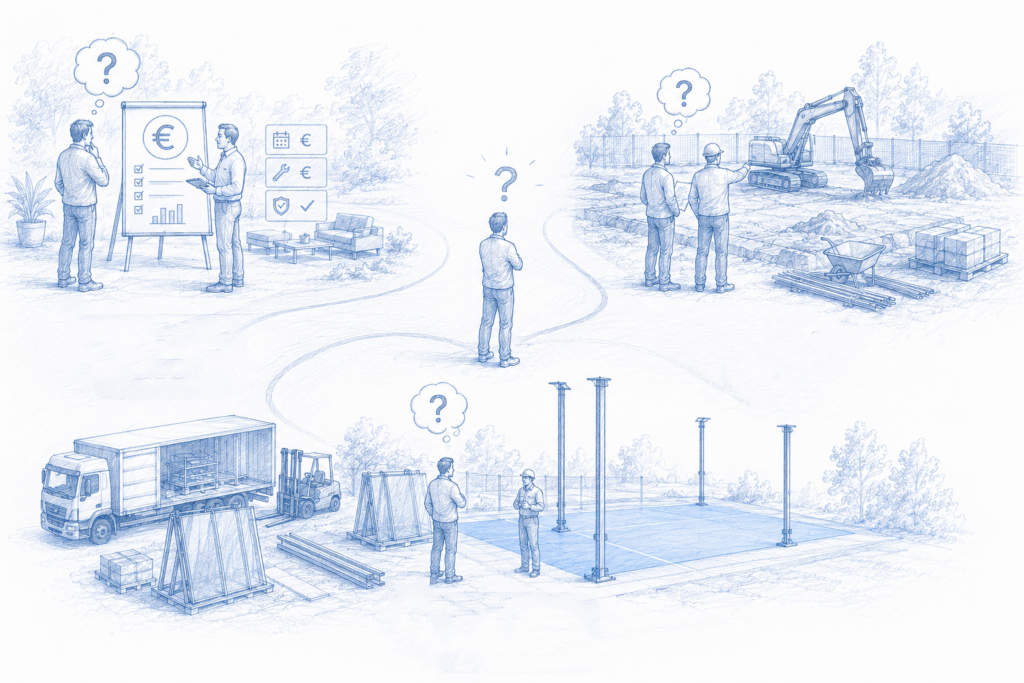
A padel club project generally involves several key stages: defining the concept and business model, site research and assessment, financing, site preparation and construction work, selecting the courts, installation, and finally operation and maintenance.
Work & Padel can support project leaders through several of these stages, from financing the courts to their maintenance once they have been installed.
There is no single ideal number that applies to all projects.
The number of courts should be determined on the basis of the available space, local demand, the proposed business model and the additional services offered by the club.
The project and site study enables a configuration to be defined that is consistent with the operator’s objectives.
The regulation playing area for a doubles padel court measures 20 metres long by 10 metres wide, or 200 m².
However, the actual land required for the project is greater than this. It is also necessary to plan for access routes, traffic flow, clearances and the layout of the areas surrounding the plots.
In a complex comprising several courts, a layout study helps to optimise the use of the available space.
To install an indoor padel court, you will need to make provision for a minimum height of 9 metres in order to ensure good playing conditions and to avoid obstructing the ball’s path.
This height must be taken into account across the entire playing area, whilst also taking into account any structural elements such as beams, lighting or technical equipment.
During the site survey, our teams check these various aspects to ensure that the building is suitable for the installation of the pitches.
Yes. Work & Padel installs indoor and outdoor padel courts.
The choice depends on the site, the operating model and the project’s objectives. Technical constraints also vary, particularly as an outdoor pitch must be suited to the outdoor conditions to which it will be exposed.
Yes, provided that the building’s layout allows the plots to be accommodated under suitable conditions.
In particular, the available floor space, height, building structure, access, ground conditions and any necessary works must be assessed before the project is approved.
A site survey enables these constraints to be identified and any necessary adjustments to be determined.
The timeframe depends on the scale of the project and its scope.
Planning, funding, administrative procedures, site preparation, construction work, the manufacture or delivery of components, and installation are all stages that can affect the timetable.
A project involving the construction or major refurbishment of a building will naturally have a different timetable to one involving the installation of courts on a site that is already ready for them.
Yes. A planning permission is required to build a padel court.
This process must therefore be factored into the overall project timetable, before work begins and the sites are set up.
The project’s characteristics, its location and local planning regulations must also be taken into account during its preparation.
02. Financing and long-term leasing
Land can be financed, for example, through a direct purchase or by means of a solution that allows the cost to be spread over time.
Work & Padel offers a solution for Long-term rental designed specifically for padel courts, enabling the financing of equipment over a period of 36 to 60 months.
The traditional purchase option also remains available to project developers wishing to become the direct owners of their land.
Long-term leasing, or LLD, allows you to use padel courts in return for a fixed monthly rent over a specified period.
With Work & Padel, financing is spread over 36 to 60 months and includes, amongst other things, the installation and maintenance of the courts.
This solution makes it possible to spread the costs over time and to preserve more investment capacity for other aspects of the project.
Investment must therefore be considered in its entirety, and not solely in terms of the cost of land.
At Work & Padel, in order to preserve some of their investment capacity, project developers can, for example, choose to finance their plots through long-term leases rather than purchasing them outright.
Work & Padel has developed its Long-Term Rental scheme as a financing solution specifically tailored to padel court projects.
Work & Padel is currently the only player in the padel market to offer this financing solution for courts.
In particular, it enables financing, installation and maintenance to be combined within a single package.
Long-term leasing makes it possible to limit the amount spent on land at the start of the project and to spread the cost over several years.
This allows the project leader to retain more investment capacity for other areas: building works, refurbishment of the clubhouse, changing rooms, catering, equipment, recruitment or communications.
Once the club has opened, the pitches can start to generate revenue whilst their funding continues.
The contracts offered by Work & Padel can range from 36 to 60 months.
The duration and terms are determined on the basis of the project and the chosen financing solution.
To install an indoor padel court, a minimum ceiling height of 9 metres is required to ensure good playing conditions and to avoid obstructing the ball’s trajectory.
This height must be taken into account across the entire playing area, whilst also taking into account any structural elements such as beams, lighting or technical equipment.
During the site survey, our teams check these various aspects to ensure that the building is suitable for the installation of the pitches.
Yes. Court maintenance is included for the entire duration of the Work & Padel Long-Term Lease agreement.
This regular maintenance helps to anticipate wear and tear, maintain the quality of the equipment and, above all, keep the pitches in like-new condition throughout the contract period, ensuring an optimal playing experience over the long term.
Yes. Long-term leasing can be used to finance several plots of land as part of the same project.
It can therefore support the establishment of a first club, an expansion, the opening of a second venue or the development of several sites.
No. It can also meet the needs of an operator wishing to develop a new site or expand their business by acquiring additional land.
The suitability of the solution depends, above all, on the project and its investment strategy.
At the end of the contract, there are two options:
- You can choose to renew the contract on favourable financial terms. This new term may, in particular, allow you to include certain services, such as replacing the lawn.
- If you do not wish to continue, the contract will end and Work & Padel will take back the courts.
Yes. Long-term leasing is at the heart of the Work & Padel financing package, but the standard purchase option is still available.
This solution is particularly aimed at project developers who wish to become the direct owners of their land and include the cost of this purchase in their initial investment.
Whichever option you choose, Work & Padel offers the same support in defining the project, selecting the courts and setting them up.
It depends on your investment strategy.
Purchasing allows you to become the direct owner of the land, whilst a long-term lease enables you to spread the cost over time and retain more investment capacity for the project’s other requirements.
The decision must therefore be considered in light of the available budget, the club’s business model and its development ambitions.
03. Sites & installation
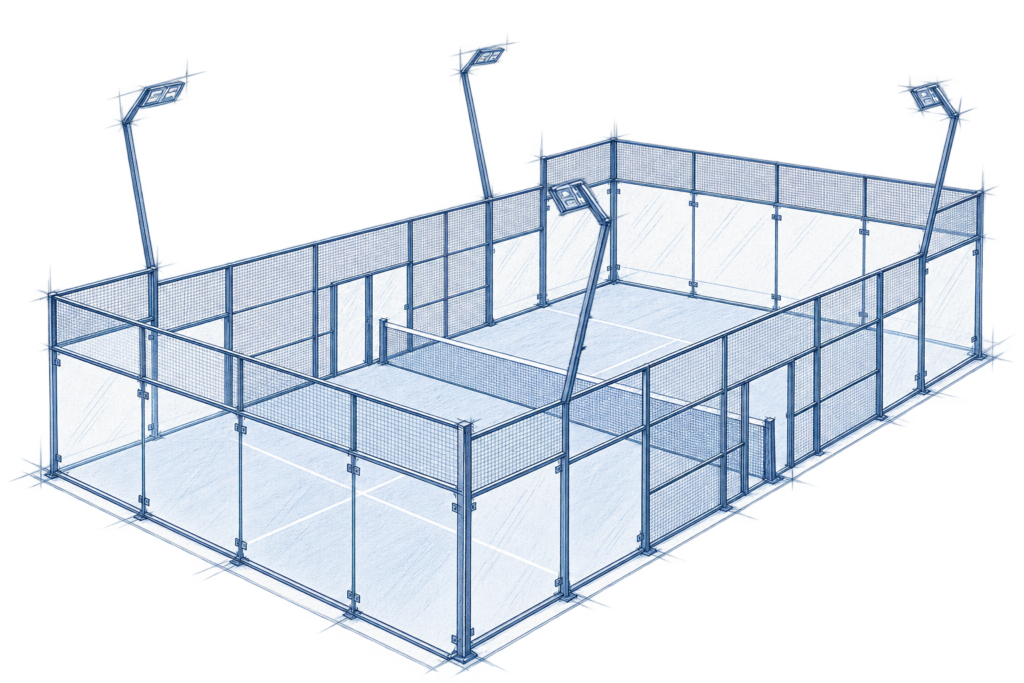
Work & Padel offers a range of court configurations to meet the needs and constraints of different projects: single court, standard court, panoramic court, full panoramic court and a freestanding system.
The model is chosen based on the available space, the club’s location, the type of experience sought and the site’s constraints.
The main difference lies in the design of the structure, the level of visibility and the aesthetic appearance of the site.
The standard model features metal mullions between each pane of glass. This design makes it a particularly robust and cost-effective solution, suitable for projects where efficiency and budget control are key priorities.
The panoramic design minimises the presence of mullions around the glazing to provide a better view of the court, whilst retaining an exposed structure.
The full panoramic design takes things a step further by minimising structural elements in the glazed areas as much as possible. It thus offers maximum visibility and a cleaner, more upmarket look, which is particularly sought after in clubs where the court design is an integral part of the experience.
A freestanding base is a solution designed to be installed without traditional ground anchoring.
The structure is based on a system that stabilises the ground without drilling into the existing substrate. This configuration can be particularly suitable for temporary projects or sites where conventional anchoring is not possible or desirable.
The choice depends on the project. The budget, available space, whether it is indoors or outdoors, the club’s positioning, the desired aesthetic, technical constraints and the experience offered to players must all be taken into account.
Our teams work with project leaders to identify the configuration that best suits their site and their objectives.
Yes. A number of features can be customised depending on the model chosen, including the colours of the frame, the turf, the logos, the safety features and certain fittings.
Customisation allows the pitches to be fully integrated into the club’s visual identity.
Yes. There are several options to consider, depending on the layout of the pitch, the type of turf chosen and the desired finish.
However, the choice of turf should not be based solely on aesthetics: its characteristics must also be suited to the court’s intended use.
Yes. Our teams carry out installations in both configurations. However, when choosing the site and its equipment, consideration must be given to its surroundings and, in the case of outdoor installations, the conditions to which it will be exposed.
The installations are carried out by teams of fitters with experience in laying padel courts.
They are involved in the various stages of installation: structure, glazing, turf, lighting, fittings and the finishing touches required before the facility is commissioned.
On average, it takes 4 days to install a padel court. However, this is only an estimate and may vary depending on the type of court, the number of courts to be installed, the layout and accessibility of the site, and the conditions at the construction site.
A detailed schedule is drawn up in advance to organise the delivery of equipment and the deployment of our teams.
Yes. The Work & Padel teams work on projects throughout France, as well as in Corsica and the overseas territories. As we have expanded, we have in particular been involved in projects in Guadeloupe and Réunion, as well as in certain international markets.
Some projects do indeed require specialised solutions: access constraints, specific site layout, mezzanine installation, temporary sites or unusual environments.
Feasibility is assessed at an early stage in order to identify any technical constraints and determine the most suitable installation solution.
04. Maintenance & After-Sales Service
A court is subjected to daily wear and tear from players and its surroundings. Maintenance helps to preserve playing conditions, the condition of the grass, the equipment and the overall appearance of the court, whilst identifying at the earliest possible stage any issues requiring attention.
Regular monitoring therefore helps to ensure the quality and durability of the installation.
Maintenance covers various aspects of the court: grass, sand, structure, glazing, nets, lighting and equipment. The work required depends, in particular, on the type of court, its surroundings and how often it is used.
The frequency depends on how often the court is used, whether it is indoors or outdoors, the type of grass and the conditions to which it is exposed.
Yes. Work & Padel’s support continues after installation with court maintenance and monitoring services. For projects financed through long-term leasing, maintenance is included for the entire duration of the contract.
Depending on the facility’s requirements, maintenance may include, amongst other things, the turf and sand distribution, the structure and glazing, the nets, the lighting and the various items of equipment. The exact scope of the work depends on the condition and layout of the pitches.
You can contact Work & Padel’s after-sales service to describe the problem you are experiencing. Our teams will assess your enquiry to identify the most appropriate solution. Depending on the situation, this may involve replacing a piece of equipment or a part and, where necessary, carrying out a site visit.
Yes. The turf can be replaced during the pitch’s lifespan when its condition so requires or when an operator wishes to upgrade the facility.
Under the Work & Padel long-term lease, the renewal of the contract may, in particular, allow for the replacement of the turf in accordance with the specified conditions.
It is important to secure the area in question and not to use the pitch if conditions do not allow for the players’ safety to be guaranteed.
You can then contact the Work & Padel after-sales service to identify the relevant glass panel and arrange for it to be replaced.
05. Work & Padel
Founded in 2017, Work & Padel now supports the creation and development of padel projects.
Originally focused on workplace wellbeing and club management, Work & Padel began specialising in the installation of courts in 2021, before developing its long-term hire solution in 2023 and expanding its operations to the overseas territories.
Today, our support services cover financing, construction, installation, maintenance and after-sales service.
Work & Padel began specialising in the installation of padel courts in 2021. Since then, we have built up our expertise project by project, working on both indoor and outdoor projects and a wide variety of configurations in France, the overseas territories and beyond.
Our approach is based on providing support that goes beyond simply selling and installing a plot of land.
Work & Padel brings together a range of specialist skills to work on a single project: financing through long-term leasing, site preparation by WP Construction, court installation, maintenance and after-sales service.
The aim is to support the project from the construction stage right through to the development of the land.
No. We work with various types of project organisers: entrepreneurs and operators of clubs, sports centres, hotels, campsites, resorts, shopping centres or other venues wishing to incorporate padel into their business.
Yes. Work & Padel also supports projects in the overseas territories, with a presence in Guadeloupe and Réunion in particular.
Depending on your requirements, Work & Padel can assist with several key stages: financing the courts, site preparation and construction work with WP Construction, installation, maintenance and after-sales service.
This allows you to benefit from a range of complementary areas of expertise brought together around a single project.
You can send us some initial details about your project via our contact form: location, number of plots envisaged, site characteristics, timetable and any specific requirements.
Our team will then be able to discuss your project with you in more detail.
You haven’t found
What is your answer?
Our team is here to listen to your ideas, discuss your project and support you.
 English (UK)
  Français